
Choosing a fishing rod manufacturer in China is not simply about comparing prices, carbon tonnage, or minimum order quantities.
A supplier that is experienced with one-piece bass rods may not be the right choice for 12 ft carp rods, heavy surf rods, jigging rods, or telescopic rods. Different rod categories require different blank designs, components, production experience, testing methods, and quality-control priorities.
For fishing brands, importers, and wholesalers, the real question is not:
"Who is the best fishing rod manufacturer in China?"
It is:
"Which manufacturer is the best fit for my target market, rod category, specifications, order volume, and development plan?"
This guide explains how to evaluate a Chinese fishing rod manufacturer before starting an OEM or private-label project.
1. Start With Your Target Market and Rod Category
Before comparing manufacturers, define what you actually want to sell.
Fishing rods are highly application-specific products. The target market, fishing method, species, price positioning, and local preferences can all influence the final specification.
For example, a U.S. bass fishing brand sourcing a one-piece 7'3" MH Fast casting rod has very different requirements from a European buyer sourcing a 12 ft carp rod.
For a one-piece bass rod, buyers may focus more on:
- Low finished weight
- Blank sensitivity and recovery
- Power and action
- Guide train and alignment
- Reel seat ergonomics
- Split-grip or full-grip handle design
- Balance in the hand
For a carp or surf rod, the priorities may shift toward:
- Casting distance
- Progressive loading
- Multi-piece connection
- Larger guide configurations
- Longer handle dimensions
- Strength under heavier casting loads
- Transport length
The same principle applies to jigging, trolling, catfish, trout, inshore, and other specialized rods.
Before requesting quotations, prepare a basic product brief:
| Requirement | Example |
|---|---|
| Target market | United States |
| Rod category | Bass casting rod |
| Length | 7'3" |
| Pieces | 1 |
| Power | Medium Heavy |
| Action | Fast |
| Line rating | 12–20 lb |
| Lure rating | 1/4–1 oz |
| Target positioning | Mid-range / Premium |
| Initial quantity | Estimated production volume |
| Customization | Logo / Components / Graphics / Development |
A clear product brief makes it much easier to compare different suppliers on the same basis.
2. Check the Manufacturer's Rod Specialization
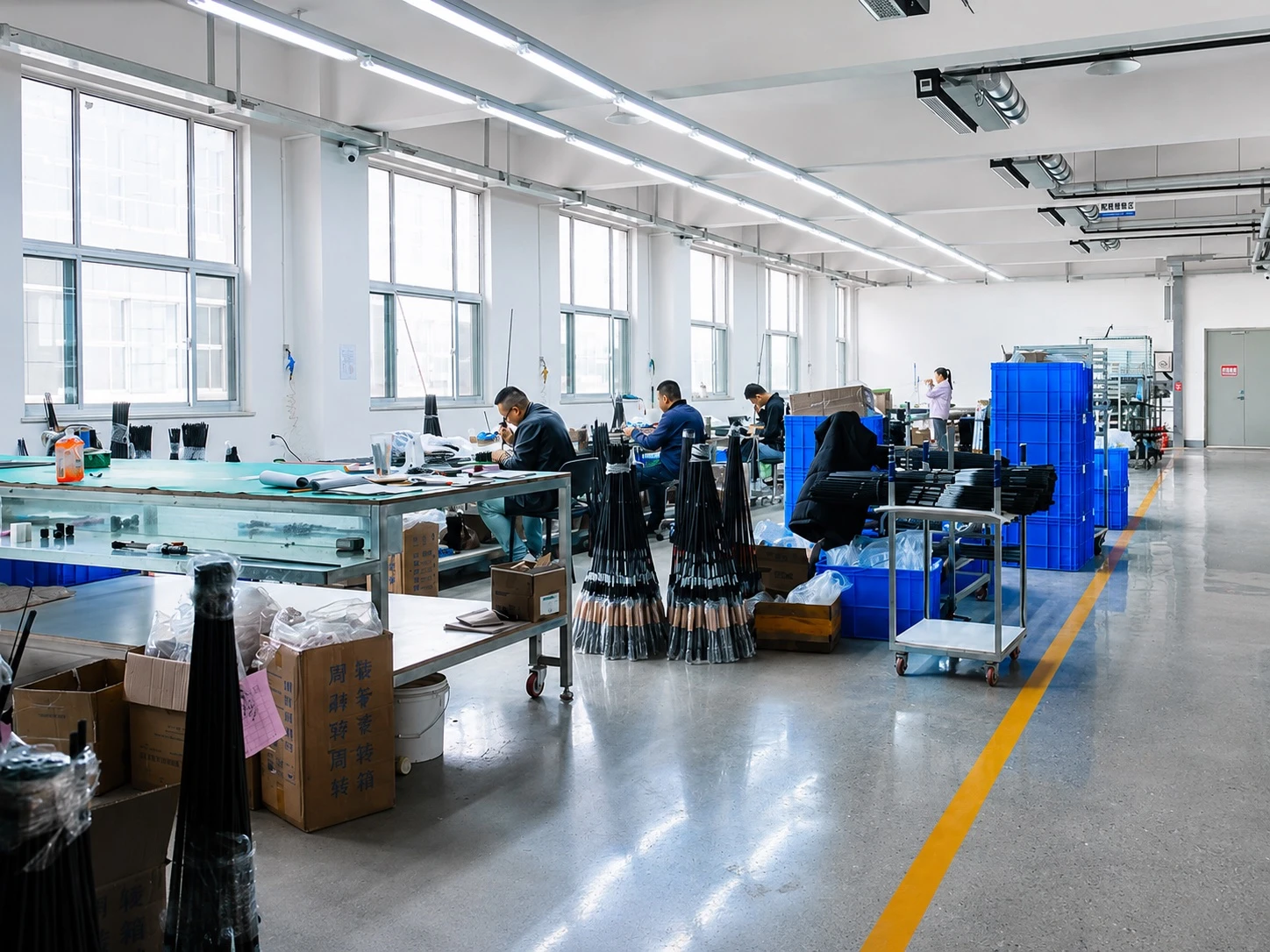
Not every fishing rod manufacturer specializes in the same products.
Some factories focus heavily on freshwater bass rods, while others have more experience with carp rods, surf rods, telescopic rods, jigging rods, boat rods, or other categories.
This specialization matters because manufacturing experience affects much more than appearance.
A supplier familiar with your rod category is more likely to understand:
- Appropriate blank characteristics
- Guide layout
- Reel seat configuration
- Handle dimensions
- Component selection
- Weight and balance targets
- Common production problems
- Relevant testing requirements
Instead of asking only:
"Can you make this rod?"
Ask:
"What similar rods are you currently producing, and what configuration would you recommend for this application?"
The quality of the answer can tell you a great deal about the manufacturer's actual product knowledge.
If you are still building a supplier shortlist, you can also compare different types of fishing rod manufacturers in China before deciding which production model best matches your project.
3. Evaluate the Blank Beyond Carbon Tonnage
Carbon tonnage is one of the most frequently discussed specifications in OEM fishing rod projects.
Buyers often request 24T, 30T, 36T, 40T, or higher-modulus carbon. However, carbon tonnage alone does not determine whether a fishing rod will perform well.
Rod performance also depends on factors such as:
- Blank construction
- Material combination
- Fiber orientation
- Resin system
- Taper design
- Wall thickness
- Blank diameter
- Reinforcement
- Manufacturing consistency
A higher-modulus carbon material can help reduce weight and improve responsiveness, but it does not automatically make a rod stronger or better suited to every fishing application.
A lightweight bass rod and a heavy catfish rod, for example, require very different compromises between sensitivity, recovery, durability, impact resistance, and lifting power.
When comparing suppliers, evaluate the complete blank design, not just the carbon-tonnage number on the specification sheet.

4. Define Power and Action by Performance, Not Just Labels
Terms such as Medium, Medium Heavy, Heavy, Fast, and Extra Fast are useful, but they are not perfectly standardized between manufacturers.
One supplier's MH Fast blank may feel noticeably different from another supplier's MH Fast blank.
This is especially important for performance-focused products such as bass rods.
A buyer should consider:
- Where the blank begins to load
- Tip responsiveness
- Recovery after flexing
- Backbone under load
- Casting behavior
- Finished rod balance
- Overall weight
- Consistency between rods
If you already have a benchmark rod that performs well in your market, sending a physical reference sample can sometimes communicate the desired performance more effectively than a long specification sheet.
The goal is not simply to reproduce labels such as MH Fast.
The goal is to reproduce the performance your target customer expects from an MH Fast rod.
5. Verify Guides, Reel Seats, and Handle Components
Components can significantly affect fishing performance, durability, appearance, and perceived retail value.
Do not rely on vague descriptions such as "high-quality guides" or "premium reel seat."
Guides
Confirm:
- Brand or supplier
- Frame material
- Ring material
- Guide count
- Guide sizes
- Guide layout
- Corrosion resistance where required
If a branded component such as Fuji is specified, confirm the actual series or model instead of accepting a general description such as "Fuji guides."
Reel Seat
Confirm:
- Brand or model
- Material
- Size
- Hood configuration
- Compatibility with the intended reel
- Ergonomics for the target fishing style
Handle
Depending on the rod, buyers may need to define:
- EVA or cork
- Material grade
- Full grip or split grip
- Rear grip length
- Foregrip design
- Butt cap
- Decorative trim components
The more important a component is to your product positioning, the more precisely it should be documented before production.

6. Understand What Can Actually Be Customized
"Custom fishing rod" can mean very different things.
For one buyer, customization may mean adding a logo to an existing rod. For another, it may involve changing guides, reel seat, handle dimensions, blank finish, graphics, and packaging. A more advanced project may require a different blank structure or performance target.
Typical fishing rod OEM options can include:
- Logo
- Blank color and finish
- Graphics
- Guide configuration
- Reel seat
- EVA or cork handle
- Grip dimensions
- Decorative components
- Butt cap
- Rod bag
- Retail packaging
More advanced development may involve:
- Blank dimensions
- Taper
- Material combination
- Reinforcement
- Power and action targets
- Other structural changes
Before choosing a manufacturer, determine whether you need private labeling, product modification, or actual product development.
A supplier suitable for adding logos to existing models is not automatically the right partner for a technically demanding new rod platform.
7. Choose the Right OEM Development Route
Most OEM fishing rod projects can be divided into three practical routes.
Route 1: Existing Rod + Branding
Use an existing production model and customize the logo, graphics, or packaging.
Suitable for: New brands, market testing, and buyers that want to reduce initial development risk.
Route 2: Existing Platform + Component Changes
Start with a proven blank or rod platform and modify selected elements such as:
- Guides
- Reel seat
- Handle
- Finish
- Graphics
- Decorative parts
- Packaging
Suitable for: Brands that want meaningful differentiation without developing the entire rod from the beginning.
Route 3: Full Custom Development
Develop a more exclusive rod around specific performance targets, blank characteristics, dimensions, components, and appearance.
This route may involve additional engineering, tooling, sampling, testing, time, and investment.
Suitable for: Established brands or projects where stronger product differentiation justifies the development cost.
For many new fishing brands, the second route offers a practical balance between differentiation, development cost, MOQ, time, and risk.
8. Order and Test Physical Samples
Fishing rods should not be evaluated from photos and specification tables alone.
A physical sample allows you to check:
- Actual power and action
- Finished weight
- Balance
- Blank straightness
- Guide alignment
- Guide spacing
- Reel seat fit
- Handle dimensions
- Finish quality
- Logo and graphics
- Epoxy workmanship
- Ferrule fit on multi-piece rods
- Casting and fishing performance
Whenever possible, test the sample under the conditions for which the rod is being developed.
A bass rod should be cast and fished with appropriate reels, line, and lure weights. A surf rod should be evaluated under the casting loads it is expected to handle.
Finding a problem during sampling is much less expensive than discovering it after mass production.
9. Check Sample-to-Bulk Consistency
A good prototype is not enough.
The next question is whether the manufacturer can reproduce the approved rod consistently across 100, 500, or several thousand pieces.
Before production, important specifications should be documented clearly.
These may include:
- Finished length
- Finished weight or acceptable tolerance
- Blank specifications
- Guide model
- Guide count and layout
- Reel seat
- Handle dimensions
- Component colors
- Logo size and position
- Graphics
- Finish
- Packaging
Quality control should compare production rods against both the approved sample and confirmed specifications.
For fishing rods, seemingly small inconsistencies can significantly affect perceived quality.
Common examples include:
- Misaligned guides
- Uneven guide spacing
- Excessive or inconsistent epoxy
- Incorrect logo position
- Poor reel seat alignment
- Different handle dimensions
- Inconsistent cosmetic finish
This is one reason why repeatable production quality can be more important than producing one impressive sample.

10. Understand MOQ, Tooling, and Lead Time
There is no single MOQ that applies to every custom fishing rod project.
MOQ can depend on:
- Rod category
- Blank
- Components
- Custom colors
- Graphics
- Packaging
- Number of specifications
- Level of customization
An existing rod with logo customization normally requires less development than a completely new rod platform.
Component choices can also affect MOQ. A custom part or special finish may have its own production minimum even when the rod itself can be produced in a smaller quantity.
Instead of asking only:
"What is your fishing rod MOQ?"
Ask how MOQ applies to:
- Each rod specification
- Colors
- Custom components
- Packaging
- New tooling, where required
Lead time should also be evaluated after the final specification is confirmed.
Specific branded components, custom parts, new blanks, and special packaging can all affect the production schedule.
11. Evaluate Fishing Rod Quality Control
Fishing rod QC should cover more than cosmetic appearance.
Depending on the project, inspection may include:
- Blank appearance and straightness
- Finished dimensions
- Finished weight
- Guide alignment
- Guide spacing
- Guide wrapping
- Epoxy finish
- Reel seat installation
- Handle assembly
- Ferrule fit
- Logo and graphics
- Component verification
- Flex or load testing
- Packaging inspection
Ask how the supplier verifies production against the approved specifications and how non-conforming rods are handled before shipment.
For a brand planning repeat orders, consistency is one of the most important indicators of a reliable manufacturing partner.
12. Plan Packaging and Transportation Early
Packaging deserves particular attention with fishing rods because rod length and fragility directly affect transportation.
This is especially important for one-piece rods.
For example, one-piece bass rods are common in the U.S. market. A 7' or 7'3" one-piece rod requires a very different export packaging and logistics plan from a two-piece or telescopic rod.
Buyers should consider:
- Individual rod protection
- Rod bags
- Poly bags
- Retail boxes
- Inner cartons
- Master cartons
- Protection around guides and rod tips
- Carton strength
- Carton dimensions
- Shipping method
Packaging should therefore be considered during product development, not after production has already been completed.

13. Compare Manufacturers Beyond Unit Price
A lower quotation does not necessarily mean a lower total sourcing cost.
When comparing fishing rod manufacturers, consider the complete product and manufacturing proposal.
| Factor | What to Evaluate |
|---|---|
| Rod specialization | Experience with your specific rod category |
| Blank capability | Construction, performance, and consistency |
| Components | Actual specifications and traceability |
| OEM capability | Branding, modification, or structural development |
| Samples | Accuracy and testing support |
| Production consistency | Ability to reproduce the approved sample |
| QC | Inspection process and defect control |
| MOQ | Whether it matches your purchasing model |
| Lead time | Production and component planning |
| Packaging | Protection and export suitability |
| Communication | Ability to understand technical requirements |
| Price | Compare only after specifications are aligned |
A $20 rod and a $30 rod may have completely different blanks, guides, reel seats, handles, finishes, QC standards, and packaging.
Compare specifications first. Compare prices second.
For a broader supplier evaluation framework beyond fishing rods, see our guide on how to choose a fishing tackle manufacturer in China
Fishing Rod Manufacturer Evaluation Checklist
Before selecting an OEM fishing rod supplier, use this checklist to compare candidates.
| What to Check | What to Ask | Warning Sign |
|---|---|---|
| Rod specialization | What similar rods do you regularly manufacture? | Only generic product claims |
| Blank | What construction and materials are used? | Focuses only on carbon tonnage |
| Power & action | Can I test a physical sample? | Relies only on specification labels |
| Guides | What exact guide specification is included? | Only says "high quality" |
| Reel seat | What brand, model, or material is used? | No clear specification |
| Handle | Can material and dimensions be confirmed? | Specifications remain vague |
| OEM capability | What can actually be customized? | Promises everything without discussing feasibility |
| Samples | Can production follow the approved sample? | Sample specifications are not documented |
| Production consistency | How is bulk production compared with the approved sample? | No clear control standard |
| QC | What is inspected before shipment? | Only basic visual inspection |
| MOQ | Is MOQ based on model, specification, color, or component? | One vague MOQ for every project |
| Lead time | When does the production timeline begin? | Firm timing before specifications are confirmed |
| Packaging | How are long rods protected during export? | Packaging discussed only after production |
Final Thoughts
Choosing a fishing rod manufacturer in China is ultimately about finding the right manufacturing fit.
Start with your target market and rod category. Define the performance you need. Verify the blank and components. Choose a realistic customization route. Test physical samples. Then determine whether the manufacturer can reproduce the approved product consistently at your required production volume.
The best supplier for a U.S. bass brand may not be the best supplier for a European carp brand-and the largest factory or lowest quotation is not automatically the best fit for every project.
For buyers still comparing potential suppliers, our Top 10 Fishing Rod Manufacturers in China guide provides an overview of different manufacturers and sourcing models.
WH Fishing works with fishing brands, importers, and wholesalers on OEM and private-label fishing rod projects, including existing rod platforms, component customization, branding, packaging, and more differentiated product development.
When contacting a manufacturer, provide your target market, rod category, specifications, estimated quantity, customization requirements, and reference products where available. A clear project brief makes it much easier for both sides to determine whether the project is a good manufacturing fit.
FAQ
1. What is the MOQ for custom fishing rods in China?
MOQ varies according to the rod type, specification, components, colors, packaging, and level of customization. An existing rod platform with branding usually has fewer development requirements than a fully customized rod project.
2. Should I choose 30T, 40T, or higher-modulus carbon for my fishing rod?
Carbon tonnage should not be selected in isolation. The appropriate material depends on the required action, power, weight, sensitivity, durability, and overall blank construction.
3. Can I customize an existing fishing rod instead of developing a new blank?
Yes. For many private-label brands, starting with an existing proven rod platform and customizing components, graphics, handles, and packaging can reduce development cost, time, and risk.
4. How should I test a fishing rod sample before ordering?
Check power, action, balance, finished weight, guide alignment, reel seat fit, handle dimensions, finish, and component specifications. Whenever possible, also conduct casting and fishing tests under the rod's intended conditions.
5. What information should I send a fishing rod manufacturer for a quotation?
Provide the rod category, length, number of pieces, power, action, line and lure ratings, target market, preferred blank and components, customization requirements, estimated order quantity, and reference images or physical samples when available.